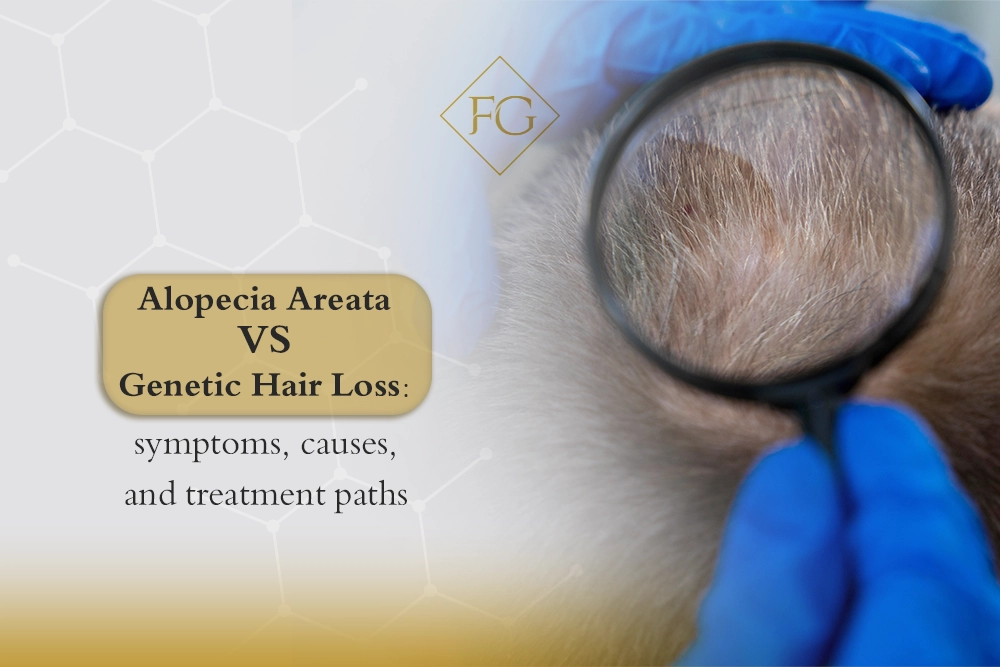
Alopecia areata vs androgenetic alopecia is the comparison many people search for the moment they notice sudden shedding, a widening part line, or a new bald patch in the mirror. You may change shampoos, start supplements, or try home remedies, yet the hair loss continues.
The confusion usually comes from not knowing which type of hair loss you’re dealing with.
Alopecia areata vs androgenetic alopecia pattern differences (photos/checklist)
The visible pattern often provides the strongest clue when distinguishing alopecia areata from androgenetic alopecia. Each condition follows a different hair thinning pattern.
| Feature | Alopecia Areata | Androgenetic Alopecia |
| Onset | Sudden | Gradual |
| Pattern | Round or oval patchy hair loss | Predictable thinning (temples, crown, part line) |
| Cause type | Autoimmune hair loss | Genetic + hormonal sensitivity |
| Speed of change | Can be rapid | Slowly progressive |
In alopecia areata, the immune system targets hair follicles, leading to clearly defined bald patches. In androgenetic alopecia, follicles gradually miniaturize, producing finer and shorter hairs over time.
Recognizing these pattern differences helps clarify the debate around alopecia areata vs androgenetic alopecia before moving to treatment. (watch this video)
Causes and risk factors
The biology behind alopecia areata vs androgenetic alopecia is fundamentally different.
Alopecia areata in Hair Treatment
- Classified as autoimmune hair loss
- May be associated with other autoimmune conditions
- Can affect scalp, beard, or eyebrows
- Often unpredictable in course
Androgenetic alopecia
- Strong genetic component
- Influenced by androgen sensitivity in hair follicles
- Follows recognizable hair thinning patterns
- More common with increasing age
Family history strongly supports androgenetic alopecia, while personal or family autoimmune history may suggest alopecia areata.
Tests doctors may request
A proper diagnosis is essential when comparing alopecia areata vs androgenetic alopecia.
A dermatologist may perform:
- Clinical scalp examination
- Dermoscopy (trichoscopy) to assess follicle miniaturization
- Hair pull test if shedding is active
- Select blood tests when clinically indicated
Testing is targeted. The goal is to confirm whether the case aligns with alopecia areata vs androgenetic alopecia, not to order unnecessary investigations. (watch this video)
Treatment options (overview)
Treatment depends entirely on whether the condition is alopecia areata or androgenetic alopecia.
For alopecia areata:
- Immune-modulating or anti-inflammatory therapies may be considered
- Some cases experience spontaneous regrowth
- Close monitoring is often required
For androgenetic alopecia:
- Minoxidil is commonly used to support follicle activity
- In-clinic therapies may be discussed depending on density and goals
- PRP may be considered as an adjunct in suitable candidates
No treatment guarantees full regrowth. Early diagnosis in alopecia areata vs androgenetic alopecia improves the chance of stabilizing loss and supporting visible improvement.
What results timeline looks like
Hair responds slowly. The timeline differs slightly between alopecia areata vs androgenetic alopecia, but realistic expectations are essential.
- First 1–2 months: stabilization phase
- Around 3–4 months: early visible changes
- 6 months and beyond: clearer evaluation of progress
Genetic hair loss requires long-term consistency, while autoimmune hair loss may fluctuate depending on immune activity.
When to book a hair assessment
Professional evaluation is recommended if you notice:
- Sudden patchy hair loss
- Progressive thinning at temples or crown
- Widening part line
- Eyebrow or beard patches
- Continued shedding despite lifestyle changes
Why choose the Dr. Faiez Ghanam Center
Choosing between alopecia areata vs androgenetic alopecia requires clinical expertise and careful scalp evaluation.
At Dr. Faiez Ghanam Center for Dermatology, Aesthetics, and Laser, each patient receives a structured hair assessment using advanced diagnostic tools and individualized planning. The focus is precision, medical safety, and natural-looking outcomes within a comfortable clinical environment in Dubai.
Book your consultation today:
Phone/WhatsApp: +971 50 135 0453
Address: Villa #6, opposite the Old Dubai Zoo, 122 Jumeirah Beach Road, Jumeirah 1, Dubai, UAE
Hours: Weekdays 9:30 AM – 9:00 PM | Friday Closed | Saturday 10:00 AM – 7:00 PM
FAQ
How can I tell alopecia areata vs androgenetic alopecia at home?
Sudden round bald patches suggest alopecia areata. Gradual thinning at the crown or temples suggests androgenetic alopecia. A dermatologist confirms the diagnosis.
Is autoimmune hair loss permanent?
Not always. Alopecia areata can be unpredictable. Some cases regrow hair, while others require treatment.
Does minoxidil work for both conditions?
Minoxidil is primarily used for androgenetic alopecia. Its role in alopecia areata depends on clinical judgment.
Does PRP guarantee regrowth?
No. PRP may support hair density in selected patients, but results vary.
Understanding alopecia areata vs androgenetic alopecia allows you to move from uncertainty to informed action. The visible pattern, medical history, and proper diagnosis determine the treatment path. When evaluated early and managed correctly, this distinction becomes manageable rather than a source of ongoing stress.